Finding where a roof leak is actually originating is harder than it sounds. Water enters at one point and travels — along rafters, battens, sarking, and sheeting — before it drips somewhere visible inside. Identifying the entry point from the interior stain alone is rarely accurate enough to guide repair.
Professional roof repair teams now use a range of diagnostic technologies that go well beyond visual inspection. Understanding what these tools do — and why they matter — helps you appreciate the value of a professional assessment over a guess-and-patch approach.
Traditional Methods vs Modern Detection
Traditional leak detection relied entirely on visual inspection: looking for obvious damage, probing suspect areas, running water with a hose while someone watched from inside. This approach works for obvious, straightforward leaks — a dislodged tile or an open flashing joint that can be directly observed.
Where it fails is on complex roofs, intermittent leaks, and moisture that has been accumulating slowly rather than entering dramatically. Modern detection technologies find leaks that visual inspection misses — and more importantly, they find them without unnecessary destructive investigation.
Why Accurate Detection Saves Money
Misidentifying a leak source leads to repairs in the wrong location — which means the actual problem continues, the repair cost is wasted, and additional damage accumulates. Accurate detection the first time means the repair addresses the actual failure point. For complex leaks, investing in professional detection is substantially cheaper than trial-and-error repairs.
Professional Leak Detection Technologies
Moisture Meters
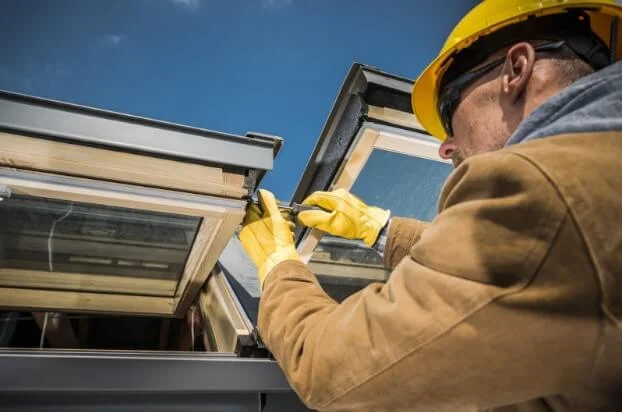
Electronic moisture meters measure the moisture content of roofing materials — including sarking, insulation, timber framing, and ceiling plasterboard. They work in two ways: pin-type meters use small probes inserted into the material surface, while pinless (non-invasive) meters use electromagnetic signals to detect moisture without penetration.
Moisture meters are particularly valuable for identifying the extent of moisture infiltration after a leak has been located — they map how far the water has spread through insulation and framing, informing how much remediation is needed beyond the surface repair.
Infrared Thermography (Thermal Imaging)
Thermal imaging cameras detect surface temperature variations across roof and ceiling surfaces. Wet materials have different thermal properties than dry materials — they hold heat longer and cool at different rates. After sunrise or following a rain event, thermal cameras can identify areas of moisture retention that are invisible to the naked eye.
This technology is especially effective on flat roofs and low-slope membranes, where moisture can be trapped beneath the membrane surface. For complex leaks in commercial buildings or large residential roofs, a thermal survey can identify affected zones accurately without any destructive investigation.
Electronic Leak Detection (ELD)
Electronic Leak Detection applies low or high voltage testing across roofing membranes to identify breaches. When voltage is applied to a waterproofing membrane and the surface is wetted, current flows at any point where the membrane is compromised. The location of current flow identifies the breach precisely.
ELD is most commonly used on flat membrane roofs — commercial buildings, roof decks, and balconies — where traditional visual inspection cannot identify pinhole-sized membrane failures. For these applications, ELD is far more accurate and cost-effective than systematic exploratory removal of membrane sections.
Drone Inspection and Aerial Photography
For large commercial roofs or complex residential rooflines where access is difficult, drones equipped with high-resolution cameras and thermal imaging provide rapid, comprehensive surveys. A drone inspection can cover a large commercial roof in a fraction of the time required for a physical walk, and captures imagery at angles that are impossible from the roof surface itself.
Drone surveys are increasingly used for post-storm damage assessment — covering significant roof areas quickly to identify damage zones and prioritise repair urgency without requiring multiple physical access points.
Why Professional Detection Matters
- Accuracy: Modern tools locate the actual entry point, not just where water appears inside
- Efficiency: Faster diagnosis means less time between problem discovery and repair
- Cost savings: Correct diagnosis the first time eliminates wasted repair cost on the wrong location
- Safety: Non-invasive detection reduces the need for exploratory destructive investigation
- Comprehensive assessment: Maps the full extent of moisture damage, not just the obvious wet spot
If you've been dealing with an intermittent or difficult-to-locate leak, read our practical homeowner guide on how to detect and repair roof leaks — it covers the signs to look for and when to escalate to a professional assessment.
Professional Diagnosis
Can't Find Where Your Roof Is Leaking?
Our team uses professional diagnostic tools to locate leaks accurately — not guess at them. Call us for an inspection and get a clear diagnosis and written repair quote.
Tags
Central Coast Roofing
Licensed roofing contractors serving Gosford, Wyong, Terrigal and all of the Central Coast NSW. Over a decade of residential and commercial roofing experience.